
Brain Fog and Poor Concentration: When Your Head Is in a Fog
Table of Contents
- What Is Brain Fog?
- Causes of Brain Fog: What Lies Behind the Mental Fog?
- Omega-3 Fatty Acids and Phospholipids: The Structural Framework of the Cell Membrane
- Citicoline and Acetyl-L-Carnitine: Two Building Blocks of Cellular Metabolism
- The B vitamin complex: Helpers for nerves, messenger substances and energy
- Magnesium: The Brake for an Overstimulated Nervous System
- Ginkgo and Brahmi: Two Plants in the Scientific Spotlight
- Conclusion: Brain Fog – Identifying Causes and Ensuring Adequate Nutrient Supply
- Frequently asked questions about Brain Fog
- Well-supplied with micronutrients
- Literature
Reading the same sentence for the third time, suddenly struggling to find a simple word in the middle of a conversation, and feeling as though your head is wrapped in cotton wool despite getting enough sleep—this phenomenon is known as "brain fog." Brain fog is not a standalone medical condition but rather an accompanying symptom that can stem from a wide variety of causes. In this guide, you will learn what happens in the brain, what might be causing difficulties with concentration, and the role that nutrients such as omega-3 fatty acids, B vitamins, and magnesium play in mental performance.
What Is Brain Fog?
Brain fog describes the feeling of moving through a mental haze: concentration noticeably drops, simple words slip one's mind, and organizing thoughts becomes an effort. It is not a standalone medical condition but rather an associated symptom that can arise from various triggers.
The brain accounts for only about 2 percent of body weight yet consumes roughly 20 percent of the body's total energy. Unlike muscles, it can barely store this energy itself and relies on a continuous supply of glucose and oxygen. If this supply falters, the brain throttles its performance—much like a computer switching to power-saving mode when overloaded.
Researchers explain this state at the cellular level: when the energy supply is persistently disrupted, the brain's support cells—which normally supply nerve cells with energy—fall out of sync. The cells absorb less glucose as an energy source, and the cell's powerhouses—the mitochondria—also operate less efficiently. The result is precisely the sensation many describe as brain fog: being awake, yet mentally sluggish.
Brain Fog Symptoms: How the Mental Fog Manifests
Brain fog primarily manifests in four areas: concentration, word retrieval, memory, and speed of thought. In everyday life, this manifests in various ways—often with an overlap of several of the following symptoms:
- Difficulty concentrating: Persistent distractibility and trouble staying focused on a task
- Word-finding difficulties: Inability to recall simple terms during conversation
- Forgetfulness: Difficulty recalling appointments, names, or recently read information
- Slowed thinking: A sensation of mental fogginess or moving through cotton wool
- Mental exhaustion: Fatigue despite adequate sleep, especially after mental exertion
- Irritability: Heightened tension and reduced stress tolerance
Causes of Brain Fog: What Lies Behind the Mental Fog?
Brain fog is usually triggered by a combination of factors: inadequate micronutrient intake, chronic stress, insufficient sleep, hormonal changes, and infections. These factors disrupt the brain's energy supply in various ways—yet the result is much the same.
Nutrient Deficiency: When the Brain Lacks Building Blocks
Nutrient deficiencies affect signal transmission between nerve cells; a lack of essential building blocks and cofactors—such as omega-3 fatty acids, B vitamins, or magnesium—causes cellular metabolism to falter.
These micronutrients play a role in processes such as building cell membranes, generating energy within mitochondria, and producing neurotransmitters—all of which are vital for seamless communication between nerve cells.
Sleep Deprivation: When Overnight Regeneration Fails
Lack of sleep has a direct impact on the brain's ability to regenerate. During deep sleep, the interstitial spaces within the brain expand, allowing cerebrospinal fluid to circulate freely and flush out metabolic waste products. If this cleansing process is interrupted by insufficient or disrupted sleep, these waste products accumulate in the brain—directly affecting concentration and cognitive performance the following day.
Additionally, during sleep, memories formed throughout the day are transferred from the hippocampus to other regions of the brain, where they are stored permanently.
If this process remains incomplete, it affects not only memory performance but also general mental acuity—a state that manifests as "brain fog" during prolonged sleep deprivation.Chronic Stress: When Cortisol Clears the Mind
Chronic stress directly impacts the brain's memory centers via the hormone cortisol. If stress persists, cortisol levels remain elevated instead of dropping towards the evening as they normally would. Persistently high cortisol levels place a strain on structurally sensitive brain regions like the hippocampus—which is central to memory formation—potentially leading to problems with concentration and memory. At the same time, chronic stress increases the body's consumption of micronutrients such as magnesium and B vitamins, which are required for stress regulation and the energy metabolism of nerve cells. How cortisol is regulated and which strategies can restore healthy levels are discussed in the guide "Lowering Cortisol – What Really Helps Against Chronic Stress."Brain Fog During Menopause: When Hormones Cloud the Mind
Menopause affects several cognitive areas due to declining estrogen levels: in the brain, estrogen influences factors such as blood flow and glucose utilization in nerve cells, making it relevant for the regions responsible for memory and concentration. As hormone levels drop during menopause, the impact can sometimes be felt directly in terms of cognitive performance. Verbal memory and working memory are particularly affected—often accompanied by mood swings and sleep disturbances that further impair mental clarity. These changes are hormonally driven and generally subside, even though they can be highly burdensome in daily life.Infections and Long COVID: When the fog lingers after the infection
Infections can sometimes affect brain function even after the acute illness has passed: the infection itself has cleared, yet concentration and the speed of thought remain noticeably impaired. This link is most widely recognized in the context of Long COVID, where "brain fog" is among the most frequently reported symptoms and can persist for weeks or months. Persistent inflammatory processes and impaired blood flow in the brain's smallest vessels—which place additional strain on the energy supply to nerve cells—are being discussed as possible explanations.Omega-3 Fatty Acids and Phospholipids: The Structural Framework of the Cell Membrane
In terms of dry mass, the brain consists of nearly 60 percent fat. The cell membranes of nerve cells are composed largely of phospholipids—special fat-like molecules that form the actual structural framework of the membrane.
The omega-3 fatty acid DHA (docosahexaenoic acid) is incorporated into these phospholipids, making it a structural building block of every nerve cell.
Why is Omega-3 beneficial for the brain?
The omega-3 fatty acid DHA is a fundamental building block of nerve cell membranes; it is found there in particularly high concentrations at the synapses—the contact points where nerve cells exchange chemical messengers.
Thanks to its molecular structure, DHA ensures that the membrane remains fluid—meaning flexible and pliable rather than rigid. This facilitates both the release of chemical messengers and the function of the receptors that receive them. Conversely, poor membrane flexibility slows down this transmission process. DHA thus contributes to the maintenance of normal brain function—an effect achieved with a daily intake of 250 milligrams of DHA.
Comprehensive analyses of multiple studies confirm that the higher the omega-3 intake, the better participants performed in areas such as attention, language skills, spatial reasoning, and general cognitive function.
In addition to DHA, an adequate supply of the phospholipid phosphatidylserine also contributes to membrane structure. It is one of the primary phospholipids found in nerve cells, where it is particularly rich in DHA.
The body’s ability to produce both DHA and phosphatidylserine on its own is limited. Regular dietary intake is therefore beneficial: DHA is primarily supplied by fatty cold-water fish such as salmon, herring, or mackerel. Algal oil is a suitable option for vegans and vegetarians. Phosphatidylserine is also found in herring and mackerel, as well as in chicken liver. Plant-based sources include white beans, soy, and sunflower seeds.
Citicoline and Acetyl-L-Carnitine: Two Building Blocks of Cellular Metabolism
Citicoline and acetyl-L-carnitine are substances produced by the body during everyday metabolic processes. Citicoline is generated during the formation of nerve cell membranes—which consist largely of fat-like building blocks (phospholipids)—whereas dietary intake of citicoline is minimal. Acetyl-L-carnitine is derived from L-carnitine, which the body produces itself to some extent and also obtains from food, particularly red meat.
Both substances provide nerve cells with vital building blocks: the body derives choline from citicoline, for instance, which is required to produce acetylcholine—a messenger substance that enables communication between nerve cells. Acetyl-L-carnitine provides another building block for acetylcholine synthesis and performs a second function: it transports fatty acids into the mitochondria, where they are converted into energy.
Research is currently underway to determine whether targeted supplementation with citicoline and acetyl-L-carnitine can also support concentration and mental performance.
The B vitamin complex: Helpers for nerves, messenger substances and energy
Nerve cells are dependent on B vitamins in several ways: They are needed for communication via messenger substances - so-called neurotransmitters -, are involved in the structure of nerve fibers and, as cofactors, enable energy production for all these processes.
If B vitamins are missing, this can affect several levels - from the Signal transmission up to the general energy level.
Vitamin B12: For nerves and energy in the head
Vitamin B12 is required for the construction of the myelin sheath - a sheath that surrounds nerve fibers like an insulating layer and ensures rapid, trouble-free transmission of stimuli.
In addition, each cell needs vitamin B12 for a specific step in the process Energy metabolism. Building blocks made of fats and proteins are introduced into the central cycle of energy production, which takes place in the mitochondria. If vitamin B12 is missing, this step stalls - with fatigue as a possible consequence.
Further signs of Vitamin B12 deficiency includes poor concentration, tingling in the hands and feet, and persistent exhaustion.
Vitamin B6: cofactor for neurotransmitters
Vitamin B6 is required in its active form for certain enzymes that convert amino acids into neurotransmitters. In this way, vitamin B6 contributes to normal psychological function and to the normal functioning of the nervous system. For example, the messenger substance serotonin is created from the amino acid tryptophan and the messenger substance dopamine is formed from the amino acid tyrosine. Both influence, among other things, mood and attention.
Pantothenic acid, vitamin B1 and niacin: cofactors in energy metabolism
Pantothenic acid, vitamin B1 and niacin take on important tasks as cofactors in the energy metabolism of every cell. They enable certain metabolic steps with which the cell obtains usable energy from food.
- Vitamin B1 is required for the breakdown of glucose, the brain's most important fuel.
- Niacin takes on a similar function in the mitochondria.
- Pantothenic acid is the starting material for coenzyme A, a central molecule in energy metabolism.
Since nerve cells have a particularly high energy requirement, a good supply of these B vitamins is important. The guide “Vitamin B complex: Effect on energy metabolism".
Magnesium: The Brake for an Overstimulated Nervous System
Magnesium is involved in more than 300 enzymatic reactions in the body, playing a role in processes such as energy metabolism and the production of neurotransmitters—two ways in which magnesium contributes to normal nervous system function and the reduction of tiredness and fatigue.
Magnesium plays a special role at so-called NMDA receptors—small docking sites on nerve cells. There, it blocks the entry of further electrical signals once the cell has been activated, acting as a brake against sensory overload. A magnesium deficiency can manifest as inner restlessness, irritability, and difficulty concentrating—symptoms typically associated with brain fog.
Not all forms of magnesium reach the brain to the same extent; magnesium L-threonate is considered a compound that is particularly effective at crossing the blood-brain barrier. Clinical studies are currently investigating whether this offers benefits for memory and concentration.
Ginkgo and Brahmi: Two Plants in the Scientific Spotlight
Plant extracts from Ginkgo biloba and Bacopa monnieri (Brahmi) are the focus of research into cognitive health.
Bacosides—the active compounds in Brahmi—are being studied for their effects against oxidative stress in nerve cells and their influence on synaptic signal transmission. Research on Ginkgo biloba is investigating whether its flavonoids and terpenoids affect blood flow and cellular protection within the brain.
Consequently, both plant compounds are combined with other micronutrients that support cognitive function in supplements.
FormMed Micronutrients for the Mind
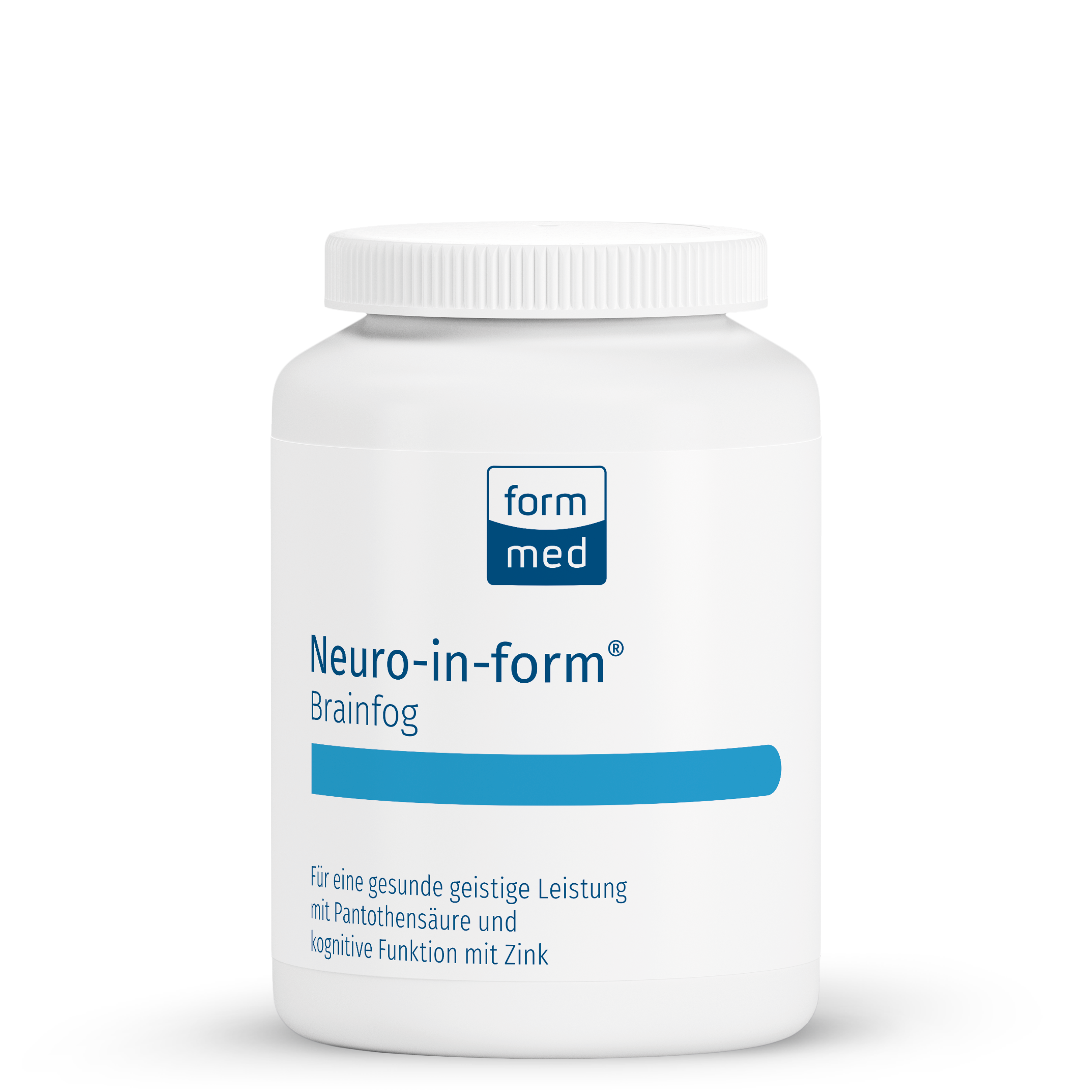
For targeted nutrient support, Neuro-in-form® Brainfog is an excellent choice: The product contains pantothenic acid to support normal mental performance and zinc for normal cognitive function, complemented by B vitamins, acetyl-L-carnitine, citicoline, phosphatidylserine, and high-quality plant extracts from Brahmi and Ginkgo biloba.
Conclusion: Brain Fog – Identifying Causes and Ensuring Adequate Nutrient Supply
Brain fog rarely has a single cause. Nutrient deficiencies, sleep deprivation, chronic stress, infections, and hormonal changes usually act in concert, placing a strain on the brain's energy supply. Key micronutrients play distinct roles in this context: omega-3 fatty acids and phospholipids form the structure of nerve cell membranes, the B-vitamin complex facilitates vital metabolic processes within the nervous system, and magnesium regulates nerve cell excitability. Additionally, substances such as citicoline, acetyl-L-carnitine, Brahmi, and Ginkgo are being studied for their roles in neurotransmitter function, energy production, and cognitive health. What matters most is not any single nutrient, but the interplay between the underlying cause and the appropriate nutritional support.
Frequently asked questions about Brain Fog
Typical symptoms of brain fog include difficulty concentrating, trouble finding the right words, forgetfulness, slowed thinking, and mental exhaustion that persists even after sufficient sleep. Irritability and reduced stress tolerance often accompany these symptoms.
Brain fog manifests primarily as the sensation of wading through cotton wool: thoughts are harder to organize, simple tasks require noticeably more effort, and those affected feel mentally sluggish despite being physically alert.
Brain fog can be triggered by various factors: chronic stress with persistently elevated cortisol levels; nutrient deficiencies—particularly in omega-3 fatty acids, B vitamins, and magnesium—resulting from an unbalanced diet; sleep deprivation; hormonal changes such as those occurring during menopause; and as a side effect of infections or chronic illnesses.
Vitamin B12 deficiency, low magnesium levels, and an inadequate supply of the omega-3 fatty acid DHA are most frequently linked to brain fog. All three nutrients are involved in signal transmission within the nervous system or in the energy metabolism of nerve cells.
Yes, important regenerative processes take place in the brain during sleep—including the removal of metabolic waste products. If this process is impaired by insufficient or disrupted sleep, it often manifests directly as poor concentration and mental exhaustion the following day.
In the vast majority of cases, no. Brain fog is usually a sign of stress, nutrient deficiency, or sleep deprivation and is generally reversible. Unlike the onset of dementia, brain fog is characterized primarily by temporary difficulties with concentration and word-finding, rather than a progressive decline in memory.
However, if symptoms persist or worsen, it is advisable to consult a doctor.
Caffeine from coffee, tea, or energy drinks can boost alertness in the short term but does not address the root cause of brain fog. In cases of underlying nutrient deficiency or chronic stress, caffeine often provides only a temporary effect; furthermore, excessive consumption can disrupt sleep and exacerbate exhaustion in the long run.
Der erste Schritt ist, mögliche Ursachen einzugrenzen: ausreichend Schlaf, ein aktives Stressmanagement und eine Überprüfung der Versorgung mit Omega-3-Fettsäuren, B-Vitaminen und Magnesium. Bleibt Brain Fog trotz dieser Maßnahmen bestehen oder verschlechtert er sich, sollte eine ärztliche Abklärung erfolgen, um Ursachen wie einen starken Vitamin-B12-Mangel oder andere behandelbare Ursachen auszuschließen.
Well-supplied with micronutrients
Ready for immediate dispatch - Delivery time approx. 1-3 days

350 mg Omega-3-Fettsäuren reich an DHA – besonders bioverfügbar
Ready for immediate dispatch - Delivery time approx. 1-3 days

Ready for immediate dispatch - Delivery time approx. 1-3 days
Literature
Barros, M. I. et al. (2025): Omega-3 Polyunsaturated Fatty Acids and Cognitive Decline in Adults with Non-Dementia or Mild Cognitive Impairment: An Overview of Systematic Reviews. Nutrients. 17(18):3002. https://pubmed.ncbi.nlm.nih.gov/41010527/
Cavalu, S. et al. (2024): Unveiling citicoline's mechanisms and clinical relevance in the treatment of neuroinflammatory disorders. FASEB J. 38(17):e70030. https://pubmed.ncbi.nlm.nih.gov/39221499/
George, M. Y. et al. (2025): The cortisol axis and psychiatric disorders: an updated review. Pharmacol Rep. 77(6):1573–1599. https://pubmed.ncbi.nlm.nih.gov/40956392/
Hanna, M. et al. (2022): B Vitamins: Functions and Uses in Medicine. Perm J. 26(2):89–97. https://pubmed.ncbi.nlm.nih.gov/35933667/
Helbing, D. L. et al. (2024): Conceptual foundations of acetylcarnitine supplementation in neuropsychiatric long COVID syndrome: a narrative review. Eur Arch Psychiatry Clin Neurosci. 274(8):1829–1845. https://pubmed.ncbi.nlm.nih.gov/38172332/
Hyndych, A. et al. (2025): The Role of Sleep and the Effects of Sleep Loss on Cognitive, Affective, and Behavioral Processes. Cureus. 17(5):e84232. https://pubmed.ncbi.nlm.nih.gov/40525051/
Johansson, B., Rönnbäck, L. (2025): The Brain Fatigue Syndrome—Symptoms, Probable Definition, and Pathophysiological Mechanisms. J Clin Med. 14(10):3271. https://pubmed.ncbi.nlm.nih.gov/40429267/
Khadilkar, S. et al. (2026): Cognition in menopausal women. Int J Gynaecol Obstet. Online ahead of print. https://pubmed.ncbi.nlm.nih.gov/41902393/
Kumar, A. et al. (2024): Magnesium (Mg): Essential Mineral for Neuronal Health: From Cellular Biochemistry to Cognitive Health and Behavior Regulation. Curr Pharm Des. 30(39):3074–3107. https://pubmed.ncbi.nlm.nih.gov/39253923/
Lopresti, A. L., Smith, S. J. (2025): The effects of magnesium L-threonate (Magtein®) on cognitive performance and sleep quality in adults: a randomised, double-blind, placebo-controlled trial. Front Nutr. 12:1729164. https://pubmed.ncbi.nlm.nih.gov/41601871/
Matthews, R. et al. (2026): Understanding the long-term neurological effects of SARS-CoV-2 infection. Nat Rev Neurol. 22(6):351–365. https://pubmed.ncbi.nlm.nih.gov/41975034/
McCorvie, T. J. et al. (2023): The complex machinery of human cobalamin metabolism. J Inherit Metab Dis. 46(3):406–420. https://pubmed.ncbi.nlm.nih.gov/36680553/
Shahinfar, H. et al. (2025): A systematic review and dose response meta-analysis of Omega 3 supplementation on cognitive function. Sci Rep. 15(1):30610. https://pubmed.ncbi.nlm.nih.gov/40836005/
Tian, J. et al. (2025): The Effects and Mechanisms of n-3 and n-6 Polyunsaturated Fatty Acids in the Central Nervous System. Cell Mol Neurobiol. 45(1):25. https://pubmed.ncbi.nlm.nih.gov/40097862/
Tripathi, P. N. et al. (2024): Review of Pharmacotherapeutic Targets in Alzheimer's Disease and Its Management Using Traditional Medicinal Plants. Degener Neurol Neuromuscul Dis. 14:47–74. https://pubmed.ncbi.nlm.nih.gov/38784601/
Valotto Neto, L. J. et al. (2024): Investigating the Neuroprotective and Cognitive-Enhancing Effects of Bacopa monnieri: A Systematic Review Focused on Inflammation, Oxidative Stress, Mitochondrial Dysfunction, and Apoptosis. Antioxidants (Basel). 13(4). https://pubmed.ncbi.nlm.nih.gov/38671841/
Varga, P. et al. (2025): The Role of Magnesium in Depression, Migraine, Alzheimer's Disease, and Cognitive Health: A Comprehensive Review. Nutrients. 17(13):2216. https://pubmed.ncbi.nlm.nih.gov/40647320/