
Diffuse hair loss and brittle nails: When the cause comes from within
Table of Contents
- What is diffuse hair loss?
- The Foundation of Keratin Production: Zinc, Biotin, and Amino Acids
- Vitamin D and Vitamin B12: Common Deficiencies in Hair Loss
- Hidden Causes: Iron Deficiency and Hormonal Shifts
- Silicon and Millet for Hair Loss – Investigated Mechanisms of Action
- Brittle Nails: A Warning Signal at Your Fingertips
- The Hair Cycle: Why Quick Results Are a Myth
- Conclusion: When hair and nails signal a deficiency
- Frequently Asked Questions About Hair Loss and Brittle Nails
- Well-supplied with micronutrients
- Literature
A hairbrush full of loose strands and nails that split at the slightest touch—for many people, this causes significant distress. Often, the first step is trying shampoos or serums, yet success remains elusive. The root cause usually lies deeper: at the hair follicle itself. In this guide, discover which nutrients the body needs to produce keratin and why regenerating the hair follicle requires a little patience.
What is diffuse hair loss?
Diffuse hair loss differs significantly from the hereditary form: unlike the latter, the hair thins evenly across the entire scalp rather than in specific areas. While hereditary hair loss (androgenetic alopecia) causes permanent damage to the hair root, the root generally remains intact in cases of diffuse hair loss. Instead, there is simply a premature shift from the growth phase to the resting phase. And—here is the good news—diffuse hair loss can usually be halted once the underlying cause is identified and addressed. Triggers include factors such as nutrient deficiency, an illness accompanied by fever, severe stress, or hormonal changes. Following such a trigger, hair growth ceases, though the hair does not actually fall out until two to six months later. By the time hair loss becomes visible, the root cause usually dates back several months.
Why do shampoos and serums often fail to help?
Shampoos, serums, and conditioners act exclusively on the hair shaft—that is, on the keratin (dead tissue) outside the scalp. However, new hair is formed in the root beneath the scalp—and that is precisely where cosmetic products do not reach.
Some anti-hair loss shampoos contain active ingredients like caffeine that stimulate scalp circulation. However, since the product is only applied for a few minutes, the contact time is usually insufficient to produce a noticeable effect at the root. The visible "instant effect" offered by many hair care products—fuller, shinier hair—is also deceptive: it is usually caused by silicones that coat the hair shaft in a fine film, making it appear thicker.
The underlying cause of hair loss remains unaffected by this.The hair root is supplied with nutrients exclusively from within via the bloodstream. Topically applied products cannot, in principle, reach it via this route.
The Foundation of Keratin Production: Zinc, Biotin, and Amino Acids
Hair and nails are largely composed of keratin, a structural protein. For the body to produce this protein in sufficient quantities, it requires the necessary building blocks and micronutrients to facilitate metabolic processes:
Biotin (vitamin B7) acts as a cofactor for enzymes that drive key steps in carbohydrate, fat, and protein metabolism. The hair root is one of the body's most metabolically active tissues: its cells divide continuously to form new hair—a process requiring significant energy and building materials. Biotin thus contributes to the maintenance of normal hair.
Zinc is involved in cell division and thereby contributes to the maintenance of normal hair and nails: hair roots continuously produce new keratin-rich cells that are steadily pushed outward, allowing the hair to grow. A lack of zinc stalls this process. Studies show that individuals with diffuse hair loss have lower zinc levels in their blood.
Sulfur-containing amino acids such as L-cysteine and L-methionine play a role in structural strength: cysteine forms sulfur bridges between molecules. These cross-links provide the solid structure found in hair and nails. L-cysteine can be obtained through diet or synthesized from L-methionine. A low-protein diet deprives the body of the building materials needed to construct this stable framework.
Why does hair fall out due to a nutrient deficiency?
Hair and nails are classified as skin appendages—the body does not need them to survive. If the body develops a deficiency in essential nutrients such as zinc, iron, or biotin, it first restricts the supply to these very "non-essential" structures in order to protect vital internal organs. The result is brittle nails and hair loss.
Vitamin D and Vitamin B12: Common Deficiencies in Hair Loss
Vitamin D and vitamin B12 are among the micronutrients essential for normal cell division—a process required wherever tissue constantly regenerates, such as in hair follicles.
An analysis of studies involving over 3,000 people—comparing those with diffuse hair loss to those with a full head of hair—reveals just how common vitamin deficiencies are in affected individuals: 72.2% had a vitamin D deficiency, and 30.7% had a vitamin B12 deficiency. A meta-analysis involving more than 10,000 participants also shows that hair loss is associated with an approximately threefold increased risk of vitamin D deficiency.
The body produces most of its vitamin D itself when the skin is exposed to sunlight; consequently, deficiencies are common in this region, particularly during the winter months when sunlight is scarce. In contrast, vitamin B12 is found almost exclusively in animal-based foods, meaning that people following a vegan or vegetarian diet are particularly at risk of deficiency.
Another risk factor for a vitamin B12 deficiency is age: absorption via the gastrointestinal tract decreases in older age, making seniors more prone to developing a deficiency. A blood test performed by a general practitioner can determine whether a deficiency exists.Hidden Causes: Iron Deficiency and Hormonal Shifts
Biotin and similar nutrients are known as "hair nutrients"—many people specifically turn to supplements containing them when experiencing hair loss. Iron deficiency and hormonal changes, however, are less frequently considered, even though they are among the most common causes.
Iron contributes to oxygen transport in the body as a component of hemoglobin, which carries oxygen through the blood to the tissues. Hair roots are among the most metabolically active tissues and rely on a continuous supply of oxygen for the constant formation of new cells. Iron deficiency is particularly common in women, as iron is regularly lost through menstruation. Several studies show that women with diffuse hair loss also have low ferritin levels, a marker for iron stores.
Regarding hormonal causes, estrogen levels are a primary focus: if they drop—such as during premenopause—the body's balance of male hormones shifts, which can affect the hair growth cycle. Thyroid dysfunction, severe stress, or a sudden drop in hormones after childbirth are also known hormonal triggers for diffuse hair loss.
Silicon and Millet for Hair Loss – Investigated Mechanisms of Action
In addition to conventional micronutrients, research is also being conducted into the effects of silicon and millet extract on hair loss.
Silicon is a trace element concentrated primarily in connective tissue, bones, skin, hair, and nails; it is absorbed as water-soluble silicic acid, the form in which it also circulates in the blood. In plant-based sources such as grains and vegetables, silicon is usually present in a bound form, whereas in beer and mineral water, it is already dissolved as silicic acid. Researchers are investigating whether silicon improves the condition of the skin and hair.
Millet plays a dual role in the context of hair loss: firstly, it is one of the grain varieties richest in silicon. Secondly, it contains a specific plant compound called miliacin, which is being studied independently of the silicon content; a study involving women with diffuse hair loss examined how miliacin affects cell division. Cell division is responsible for the formation of new hair substance during the growth phase.
Brittle Nails: A Warning Signal at Your Fingertips
Brittle nails are often viewed as a purely cosmetic issue. Yet, they can serve as a visible early warning signal of a micronutrient deficiency—even before hair loss becomes apparent.
Typical changes in the nails include:
- Horizontal ridges, which indicate a temporary disruption in growth—for example, following an illness or a period of stress
- Vertical ridges, which increase with the natural aging process but can also become more pronounced due to nutrient deficiency
- Soft, brittle nails or white horizontal bands, which often point to a zinc deficiency
- Spoon-shaped nails, which indicate an iron deficiency
As with hair, the root cause usually lies not on the nail's surface, but in the body's internal supply of nutrients.
The Hair Cycle: Why Quick Results Are a Myth
Hair does not grow continuously; instead, it goes through a recurring cycle consisting of three phases:
- Anagen phase (growth phase): The hair grows actively—this phase lasts several years.
- Catagen phase (transition phase): The hair detaches from the root—a brief restructuring phase lasting a few weeks.
- Telogen phase (resting phase): The hair stops growing and falls out at the end of this phase—after which a new cycle begins in the same root.
This has an important implication: if a nutrient deficiency is corrected, the results do not appear immediately. The hair follicle must first regenerate and start a new growth cycle—a process that typically takes two to three months. So, a little patience is required here.
FormMed Tip – Micronutrients for Hair and Nails
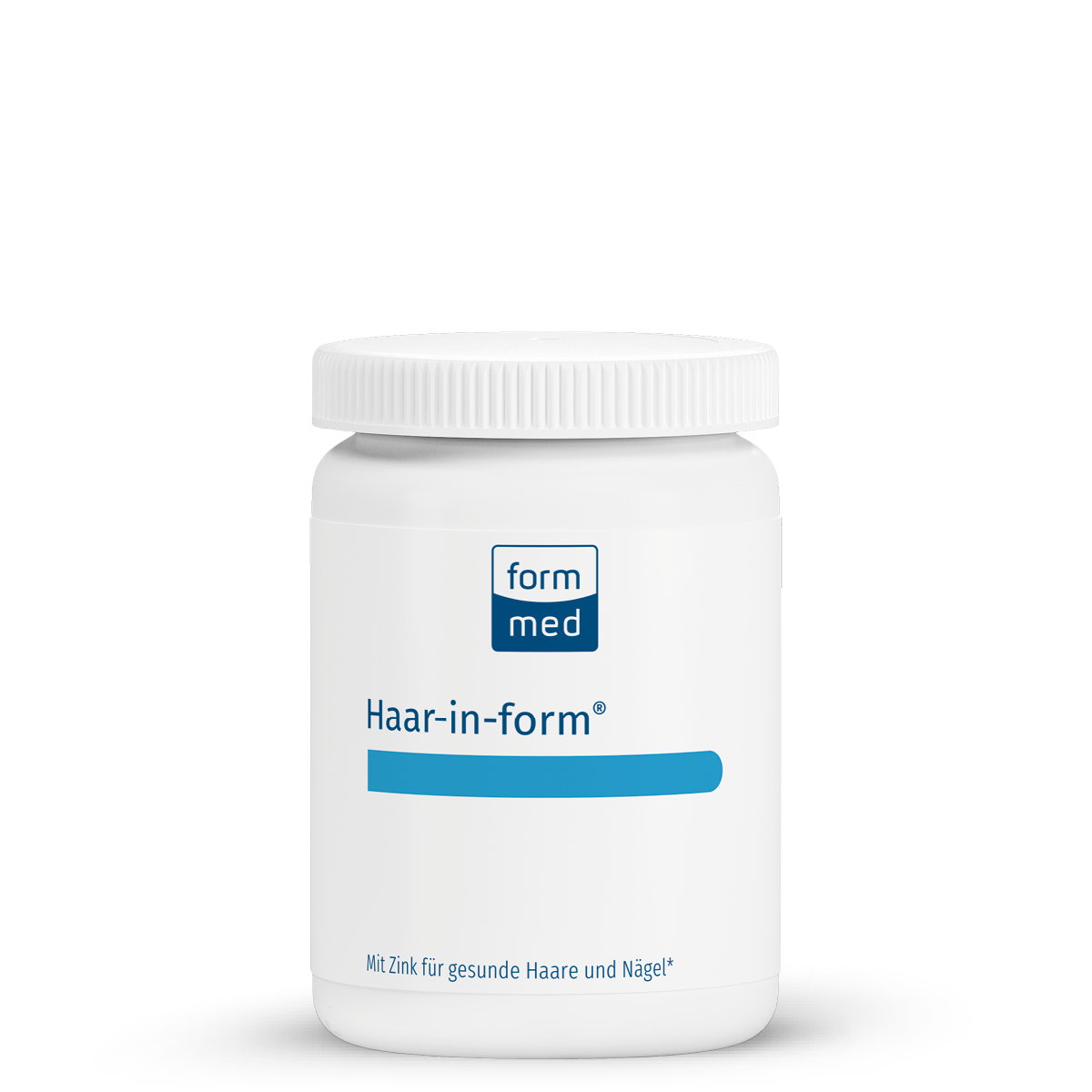
Combination supplements make it easier to ensure a targeted supply of several key micronutrients. Haar-in-form multi+ contains, among other ingredients, zinc, which contributes to the maintenance of normal hair and nails. The supplement is complemented by bamboo and millet extracts, as well as the amino acids L-cysteine and L-methionine.
Conclusion: When hair and nails signal a deficiency
Diffuse hair loss and brittle nails are rarely just a cosmetic issue. They are often caused by a deficiency in zinc, biotin, iron, vitamin D, vitamin B12, or amino acids—or sometimes by hormonal changes. These nutrients provide the building blocks for keratin formation and cell division in the hair root, whereas cosmetic products only work on the surface.
It takes several months for a balanced supply of nutrients to have a visible effect on hair and nails—this is due to the natural hair growth cycle. Patience is therefore just as important as the right internal nourishment.
Frequently Asked Questions About Hair Loss and Brittle Nails
Losing 100 to 150 hairs a day is considered normal and is no cause for concern. This number fluctuates throughout the year: more hair often falls out in autumn than in summer.
Simply replenishing biotin levels usually has limited effect, as a genuine biotin deficiency is rare in this region given a balanced diet. It is more beneficial to replenish all relevant micronutrients—particularly in cases of confirmed iron or zinc deficiency, which occur much more frequently.
It is advisable to consult a doctor if hair loss is unusually severe or persists for several months, if circular, clearly defined bald patches appear, or if additional symptoms such as extreme fatigue, menstrual irregularities, sensitivity to cold, or a racing heart occur.
Diffuse hair loss can be partly hormonal in origin—for example, due to falling estrogen levels or an underactive thyroid. However, non-hormonal causes such as iron deficiency, stress, or an infection are also frequently at the root of the problem.
In most cases, diffuse hair loss is reversible, as the hair root remains intact with this type of hair loss. If the underlying cause—such as an iron deficiency—is addressed, hair growth can return to normal.
Yes, diffuse hair loss can generally be reversed: unlike hereditary hair loss, the hair follicle remains intact and can resume normal production of new hair once the underlying cause has been eliminated.
Acute forms of diffuse hair loss usually last up to six months and resolve on their own. If the hair loss persists for more than six months, it is classified as chronic—depending on how quickly the cause is identified and remedied.
Once the cause has been identified and resolved, hair loss often returns to normal within two to three months. The hair needs some time to begin a new hair cycle.
Yes, frequent painting, acetone-based nail polish remover, and constant contact with water or cleaning agents strip the nail of moisture and flexibility—regardless of internal nutrient levels.
There is no single "best remedy." The decisive factor is whether the cause lies in mechanical stress, a lack of moisture, or a nutrient deficiency—particularly of zinc. Only then can targeted countermeasures be taken.
Wearing gloves during household chores, regularly applying cream to the cuticles, and ensuring an adequate supply of nutrients are typical measures for addressing brittle nails.
Longitudinal ridges are often caused by aging or nutritional deficiencies. Since micronutrients such as zinc and protein play a role in the formation of nail keratin, a balanced intake supports nail structure. Additionally, it is advisable to avoid harsh cleaning agents and to care for the nails regularly.
Nails can be strengthened in two ways: from the outside through care and protection against stress, and from the inside through sufficient micronutrients and protein building blocks—which provide the raw materials for producing nail keratin. Patience is required, as it takes a fingernail around six months to grow back completely.
Well-supplied with micronutrients

Ready for immediate dispatch - Delivery time approx. 1-3 days
Ready for immediate dispatch - Delivery time approx. 1-3 days

Ready for immediate dispatch - Delivery time approx. 1-3 days
Literature
Barel, A. et al. Effect of oral intake of choline-stabilized orthosilicic acid on skin, nails and hair in women with photodamaged skin. Arch Dermatol Res. 2005;297(4):147-153. https://pubmed.ncbi.nlm.nih.gov/16205932/
Durusu Turkoglu, I. N. et al. (2024): A comprehensive investigation of biochemical status in patients with telogen effluvium: Analysis of Hb, ferritin, vitamin B12, vitamin D, thyroid function tests, zinc, copper, biotin, and selenium levels. J Cosmet Dermatol. 23(12):4277-4284. https://pubmed.ncbi.nlm.nih.gov/39107936/
Ferrándiz, C. et al. (1981): Acquired Zinc Deficiency Syndrome during Total Parenteral Nutrition. Dermatologica. 163(3):255-266. https://pubmed.ncbi.nlm.nih.gov/6456952/
Hughes, E. C. et al. D. (2024): Telogen Effluvium. In: StatPearls [Internet]. Treasure Island (FL): StatPearls Publishing. https://www.ncbi.nlm.nih.gov/books/NBK430848/
İbiş, S. und Aksoy Saraç, G. (2022): Evaluation of MCV/RDW Ratio and Correlations With Ferritin in Telogen Effluvium Patients. Dermatol Pract Concept. 12(3):e2022151. https://www.ncbi.nlm.nih.gov/pmc/articles/PMC9464528
Kamp, E. et al. (2022): Menopause, skin and common dermatoses. Part 1: hair disorders. Clin Exp Dermatol. 47(12):2110-2116. https://pmc.ncbi.nlm.nih.gov/articles/PMC10092469/
Karakoyun, Ö. et al. (2025): Retrospective Review of 2851 Female Patients With Telogen Effluvium: A Single-Center Experience. J Cosmet Dermatol. 24(2):e70037. https://www.ncbi.nlm.nih.gov/pmc/articles/PMC11826290
Keophiphath et al. Miliacin encapsulated by polar lipids stimulates cell proliferation in hair bulb and improves telogen effluvium in women. J Cosmet Dermatol. 2019;19(2):485-493. https://pubmed.ncbi.nlm.nih.gov/31135099/
Lee, D. K. und Lipner, S. R. (2022): Optimal diagnosis and management of common nail disorders. Ann Med. 54(1):694-712. https://pubmed.ncbi.nlm.nih.gov/35238267/
Malkud, S. (2015): A Hospital-based Study to Determine Causes of Diffuse Hair Loss in Women. J Clin Diagn Res. 9(8):WC01-4. https://www.ncbi.nlm.nih.gov/pmc/articles/PMC4576621
Malkud, S. (2015): Telogen Effluvium: A Review. J Clin Diagn Res. 9(9):WE01-3. https://pmc.ncbi.nlm.nih.gov/articles/PMC4606321/
Nielsen FH. Update on the possible nutritional importance of silicon. J Trace Elem Med Biol. 2014;28(4):379-382. https://pubmed.ncbi.nlm.nih.gov/25081495/
Prasad, A. S. (2013): Discovery of human zinc deficiency: its impact on human health and disease. Adv Nutr. 4(2):176-190. https://pubmed.ncbi.nlm.nih.gov/23493534/
St Pierre, S. A. et al. (2010): Iron deficiency and diffuse nonscarring scalp alopecia in women: more pieces to the puzzle. J Am Acad Dermatol. 63(6):1070-1076. https://pubmed.ncbi.nlm.nih.gov/20888064/
Trueb, R.M. (2010): Systematisches Vorgehen bei Frauen mit Haarausfall. J Dtsch Dermatol Ges. 8:284–297. https://www.rosenfluh.ch/media/dermatologie-aesthetische-medizin/2010/03/Systematisches_Vorgehen_beim_diffusen_Haarausfall_der_Frau.pdf
Tully, A. S., Trayes, K. P. und Studdiford, J. S. (2012): Evaluation of nail abnormalities. Am Fam Physician. 85(8):779-787. https://pubmed.ncbi.nlm.nih.gov/22534387/
Yorulmaz, A. et al. (2021): Telogen effluvium in daily practice: Patient characteristics, laboratory parameters, and treatment modalities of 3028 patients with telogen effluvium. J Cosmet Dermatol. 21(6):2610–2617. https://pubmed.ncbi.nlm.nih.gov/34449961/