Quercetin – does it also have an effect in the gut?
Quercetin is a flavonoid known for its anti-inflammatory properties. Flavonoids are secondary plant compounds that naturally protect plants from environmental influences such as sunlight, predators or bacteria. These plant compounds also play a role in human health and are an important component of a balanced diet. New scientific findings show that quercetin from food may also play an important role in the gut.
Read on to learn how quercetin works, what significance it may have for gut health and which foods contain particularly high amounts of it.
Quercetin: Antioxidant and Anti-Inflammatory
Scientific interest in quercetin is growing. Its mechanisms of action have already been examined in numerous studies. Quercetin shows
- anti-inflammatory properties: The plant compound influences immune cells and messenger substances such as histamine, which can help reduce inflammatory markers in the blood.
- antioxidant effects: Quercetin is among the strongest antioxidants. It helps neutralize free radicals, which in excess may contribute to oxidative stress. Oxidative stress is involved in inflammatory processes and can potentially affect cells.
Effects of Quercetin in the Gut: Findings from Nutrition Studies
A diet rich in flavonoids such as quercetin appears to have a beneficial influence on gut health. One dietary study showed that when individuals consumed an average of 340 milligrams of quercetin per 1,000 kilocalories, their gut barrier was less permeable compared to those who consumed only 10 milligrams per 1,000 kilocalories. A stronger gut barrier helps limit the passage of unwanted substances from the environment into the body.
In addition, flavonoids were associated with favorable effects on markers related to inflammation in the gut. Researchers also discuss whether flavonoids may support the gut microbiota in a way comparable to dietary fiber. Other flavonoids besides quercetin include rutin and green tea EGCG.
Chronic Inflammatory Bowel Diseases
Chronic inflammation in the gut can become pathological. In this case, they are referred to as chronic inflammatory bowel diseases. A distinction is made between Crohn’s disease and ulcerative colitis. In ulcerative colitis, inflammation occurs in the last section of the intestine, the rectum. Crohn’s disease, on the other hand, can affect the entire small and large intestine and may even appear in the mouth or esophagus.
Diet can influence the course of these conditions. Two observational studies found that a higher intake of quercetin through food was associated with:
- a lower risk of ulcerative colitis,
- fewer complications related to Crohn’s disease.
Quercetin in Foods
Quercetin is widely found in fruits and vegetables, but it is concentrated mainly in the peel. If the peel is not consumed, quercetin intake is significantly lower. For example, an apple with peel contains between 2 and 4 milligrams per 100 grams depending on the variety, whereas a peeled apple provides less than 1 milligram.
Red onions are particularly rich in quercetin (32 milligrams per 100 grams), as are culinary herbs such as lovage (170 milligrams per 100 grams). Although herbs contain high amounts of quercetin, they are typically consumed in small quantities: one tablespoon of chopped herbs amounts to about 4 grams.
Conclusion: Quercetin for Gut Health
Quercetin is an important plant-based compound that should be part of a balanced diet. It has anti-inflammatory and antioxidant properties in the body. These properties also apply to the gut, where quercetin may help support gut health.
If you are considering taking quercetin capsules, it is advisable to consult a micronutrient specialist. They can answer questions about dosage and about when and how long quercetin should be taken. A therapist can also provide information on possible side effects and interactions.
Suitable FormMed Supplements
Ready for immediate dispatch - Delivery time approx. 1-3 days
Ready for immediate dispatch - Delivery time approx. 1-3 days
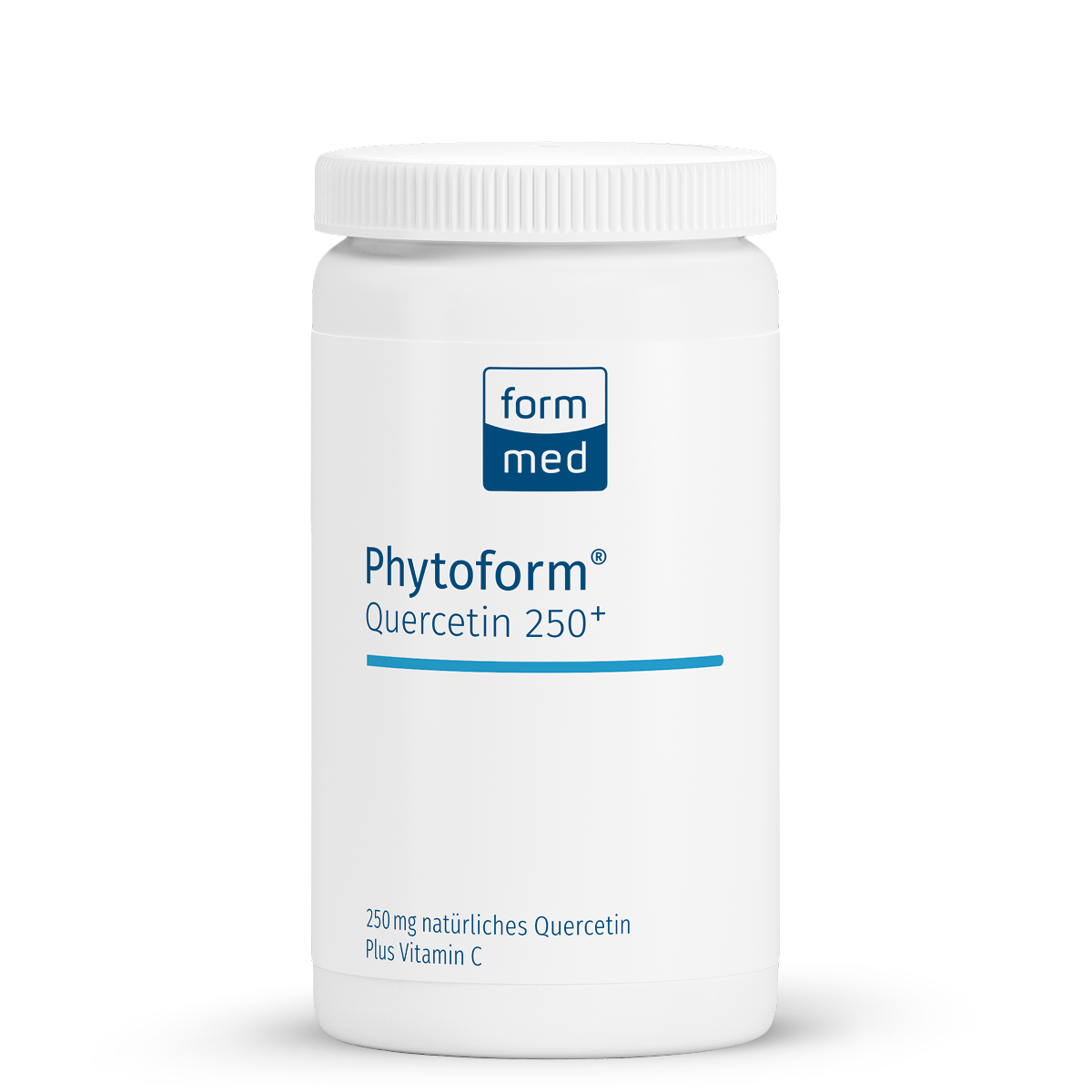
250 mg natural quercetin from Japanese pagoda tree flowers – plus vitamin C
Ready for immediate dispatch - Delivery time approx. 1-3 days
References
Askari, G. et al. (2012): The effect of quercetin supplementation on selected markers of inflammation and oxidative stress. J Res Med Sci. 17(7):637-41. https://pubmed.ncbi.nlm.nih.gov/23798923/
Bhagwat, S. et al. (2011): USDA Database for the Flavonoid Content of Selected Foods, Release 3 (PDF). U.S. Department of Agriculture. https://www.ars.usda.gov/ARSUserFiles/80400525/Data/Flav/Flav_R03.pdf
Dehghani, F. et al. (2021): Effects of quercetin supplementation on inflammatory factors and quality of life in post-myocardial infarction patients: A double blind, placebo-controlled, randomized clinical trial. Phytother Res. 35(4):2085-2098. https://pubmed.ncbi.nlm.nih.gov/33216421/
Egert, S. et al. (2008): Daily quercetin supplementation dose-dependently increases plasma quercetin concentrations in healthy humans. J Nutr. 138(9):1615-21. https://pubmed.ncbi.nlm.nih.gov/18716159/
Haytowitz, D. B. et al. (2018): USDA Database for the Flavonoid Content of Selected Foods. Release 3.3. https://www.ars.usda.gov/ARSUserFiles/80400535/Data/Flav/Flav3.3.pdf
Hu, S. et al. (2022): Preclinical evidence for quercetin against inflammatory bowel disease: a meta-analysis and systematic review. Inflammopharmacol 30, 2035–2050. https://link.springer.com/article/10.1007/s10787-022-01079-8
Lu, S.-Y. et al. (2024): Dietary quercetin intake is associated with lower ulcerative colitis risk but not Crohn's disease in a prospective cohort study and in vivo experiments. Food Funct. May 29. https://pubmed.ncbi.nlm.nih.gov/38807501/
Lyu, Y.-L. et al. (2022): Biological Activities Underlying the Therapeutic Effect of Quercetin on Inflammatory Bowel Disease. Mediators Inflamm. 5665778. https://www.ncbi.nlm.nih.gov/pmc/articles/PMC9338876/
Mohammadi-Sartang, M. et al. (2017): Effects of supplementation with quercetin on plasma C-reactive protein concentrations: a systematic review and meta-analysis of randomized controlled trials. Eur J Clin Nutr. 71(9):1033-1039. https://pubmed.ncbi.nlm.nih.gov/28537580/
Sato, S. & Mukai, Y. (2020): Modulation of Chronic Inflammation by Quercetin: The Beneficial Effects on Obesity. J Inflamm Res. 13:421-431. https://pubmed.ncbi.nlm.nih.gov/32848440/
Ward, R. E. et al. (2016): A High Flavonoid Diet Reduces Gut Permeability, Short Chain Fatty Acid Production and Decreases Gut Inflammation in Overweight and Obese Men and Women. The FASEB Journal 30:1:420.5. http://www.fasebj.org/content/30/1_Supplement/420.5
Wang, T. et al. (2024): Higher Dietary Quercetin Intake Is Associated with Lower Risk of Adverse Outcomes among Individuals with Inflammatory Bowel Disease in a Prospective Cohort Study. J Nutr. S0022-3166(24)00229-3. https://pubmed.ncbi.nlm.nih.gov/38677479/