Estrogen dominance and progesterone deficiency: Supporting hormonal balance
Table of Contents
- Absolute or relative: What does estrogen dominance really mean?
- The Liver: A Key Organ for Hormone Breakdown
- Vitamin B6: A Cofactor in Hormone and Neurotransmitter Metabolism
- Magnesium: A Cofactor for Numerous Metabolic Processes
- The Gut: The Second Stage in Estrogen Breakdown
- Chasteberry (Vitex agnus-castus): Plant Extract in Research on the Female Cycle
- Conclusion: A Holistic Perspective on Estrogen Dominance and Progesterone Deficiency
- Frequently Asked Questions About Estrogen Dominance and Progesterone Deficiency
- Well-supplied with micronutrients
- Literature
Many women are familiar with breast tenderness, mood swings, or water retention before their period—these are all part of a normal menstrual cycle. However, if these symptoms are particularly pronounced, or if they are accompanied by unexplained weight gain in the abdomen and thighs, the term "estrogen dominance" often comes up. In most cases, this does not actually refer to an excess of estrogen, but rather to a deficiency in its counterpart, progesterone.
In this guide, you will learn how this imbalance develops, the role that the liver and gut play in the breakdown of hormones, and which micronutrients are essential for hormone metabolism.
Absolute or relative: What does estrogen dominance really mean?
The term "estrogen dominance" is not an official medical diagnosis. Originating from functional and complementary medicine, it describes an imbalance between the two primary female sex hormones: estrogen and progesterone.
A distinction is made between two types:
In cases of absolute estrogen dominance, there is actually a higher-than-normal amount of estrogen in the body—for example, if the liver’s ability to break down estrogen is impaired, or if additional estrogen is introduced from an external source. This form is rare.
Much more common is relative estrogen dominance: here, the level of estrogen remains largely normal, but there is a deficiency of its counterpart, progesterone. Without this balancing hormone, the existing estrogen becomes dominant by comparison.
During the menstrual cycle, these two hormones serve distinct functions: in the first half of the cycle, estrogen builds up the uterine lining and stimulates cell growth. Following ovulation, the empty follicle develops into the corpus luteum, which produces significant amounts of progesterone.
In the second half of the menstrual cycle, progesterone plays a counterbalancing role: it relaxes the uterine muscles and prepares the tissue for a potential pregnancy.From the mid-30s onwards, the number of cycles without ovulation increases—a trend that becomes even more pronounced during perimenopause, the hormonal transition phase that typically begins around age 40. If ovulation does not occur, no corpus luteum is formed, and consequently, very little progesterone is produced. This shifts the balance between the two hormones in favor of estrogen.
Symptoms of Estrogen Dominance and Progesterone Deficiency
The symptoms of estrogen dominance and progesterone deficiency are very similar, as both describe the same underlying imbalance. Those affected may experience a wide range of different complaints.
Typical symptoms include:
- Breast tenderness and pain before menstruation
- Water retention, particularly in the legs and abdomen
- Mood swings, irritability, and inner restlessness
- Irregular or heavier menstrual bleeding, sometimes accompanied by more intense period pain
- Weight gain, occurring despite no changes to one’s diet
- Headaches and sleep disturbances during the second half of the menstrual cycle
When is it advisable to consult a doctor?
Persistent irregular or very heavy bleeding, the absence of a period for several months, difficulty conceiving, or severe, distressing mood swings should be evaluated by a physician.
A gynecological or endocrinological examination can determine whether a progesterone deficiency is actually present or if an underlying medical condition is the cause—such as a thyroid disorder, PMOS (formerly PCOS), endometriosis, uterine fibroids, or a depressive disorder.
The Liver: A Key Organ for Hormone Breakdown
To keep estrogen levels in balance, the body must continuously break down excess or spent estrogen. The liver primarily handles this task through a two-stage process:
- In the first stage, the body’s own enzymes alter the structure of estrogen molecules.
- In the second step, these intermediate products undergo chemical reactions that make them easier for the body to excrete—either via the kidneys in urine or through the bile into the stool.
One of these chemical pathways is known as methylation: A specific enzyme (catechol-O-methyltransferase, or COMT) attaches a small chemical group to the estrogen intermediate, rendering it ready for excretion. For this step, COMT requires a building block called SAM (S-adenosylmethionine). In turn, the body can only produce sufficient amounts of SAM if it has an adequate supply of certain B vitamins, which act as cofactors.
If the liver is heavily burdened by other tasks—such as breaking down alcohol or medications, or processing a high intake of hormonally active environmental substances—it may have less capacity available for breaking down estrogen. There is also discussion as to whether chronic stress may further contribute to this effect. The result can be an increased accumulation of estrogen within the body.
What are xenoestrogens, and do they promote estrogen dominance?
Xenoestrogens are environmental compounds with a chemical structure similar to that of the body’s own estrogen. They are found in various sources, including plasticizers like bisphenol A (BPA) in plastic packaging, parabens in cosmetic products, certain pesticides, and the thermal coating on cash register receipts.
In cell and animal models, these compounds can bind to estrogen receptors and trigger hormone-like signals. Whether—and to what extent—this contributes to specific health issues in humans has not yet been definitively established by science. Nevertheless, expert bodies such as the Endocrine Society recommend, as a precautionary measure, that exposure to these substances be reduced.
Vitamin B6: A Cofactor in Hormone and Neurotransmitter Metabolism
Among the B vitamins required for chemical conversion reactions in the liver, vitamin B6 plays a special role: beyond this function, it is also directly involved in the metabolism of hormones and neurotransmitters. In its active form, pyridoxal-5-phosphate, vitamin B6 acts as a cofactor for numerous enzymes in the metabolism of steroid hormones, which include estrogen and progesterone. It therefore contributes to the regulation of hormonal activity.
Furthermore, vitamin B6 is essential for the normal functioning of the nervous system and the psyche: as a cofactor, it supports the production of the neurotransmitters serotonin and GABA (gamma-aminobutyric acid) in the brain. These neurotransmitters influence mood, motivation, and sleep—factors that often play a role in cases of progesterone deficiency.
To ensure these processes continue to function effectively over the long term, the body requires an adequate dietary intake of vitamin B6. Good sources of vitamin B6 include chickpeas, poultry, salmon, potatoes, and bananas.
Magnesium: A Cofactor for Numerous Metabolic Processes
Along with B vitamins, magnesium serves as a cofactor for hundreds of enzymes in the body, playing a role in a wide variety of metabolic processes.
Magnesium contributes to normal muscle function as well as normal psychological function. As a natural antagonist to calcium, it regulates cellular excitability. In muscle cells, calcium facilitates contraction, while in nerve cells, it enables the transmission of stimuli. If magnesium is lacking, the activating effect of calcium becomes dominant—a shift in balance that can contribute to muscle tension and mood swings, both of which are common in cases of estrogen dominance caused by a progesterone deficiency.
Magnesium also acts as an essential cofactor in the liver. Here, the enzyme COMT processes estrogen intermediates, making them easier for the body to excrete. COMT requires magnesium to perform this step; without it, the necessary chemical reaction cannot take place.
Good dietary sources of magnesium include pumpkin seeds, nuts, legumes, whole-grain products, and green leafy vegetables such as spinach.
FormMed Tip: Micronutrient Combination for the Female Cycle
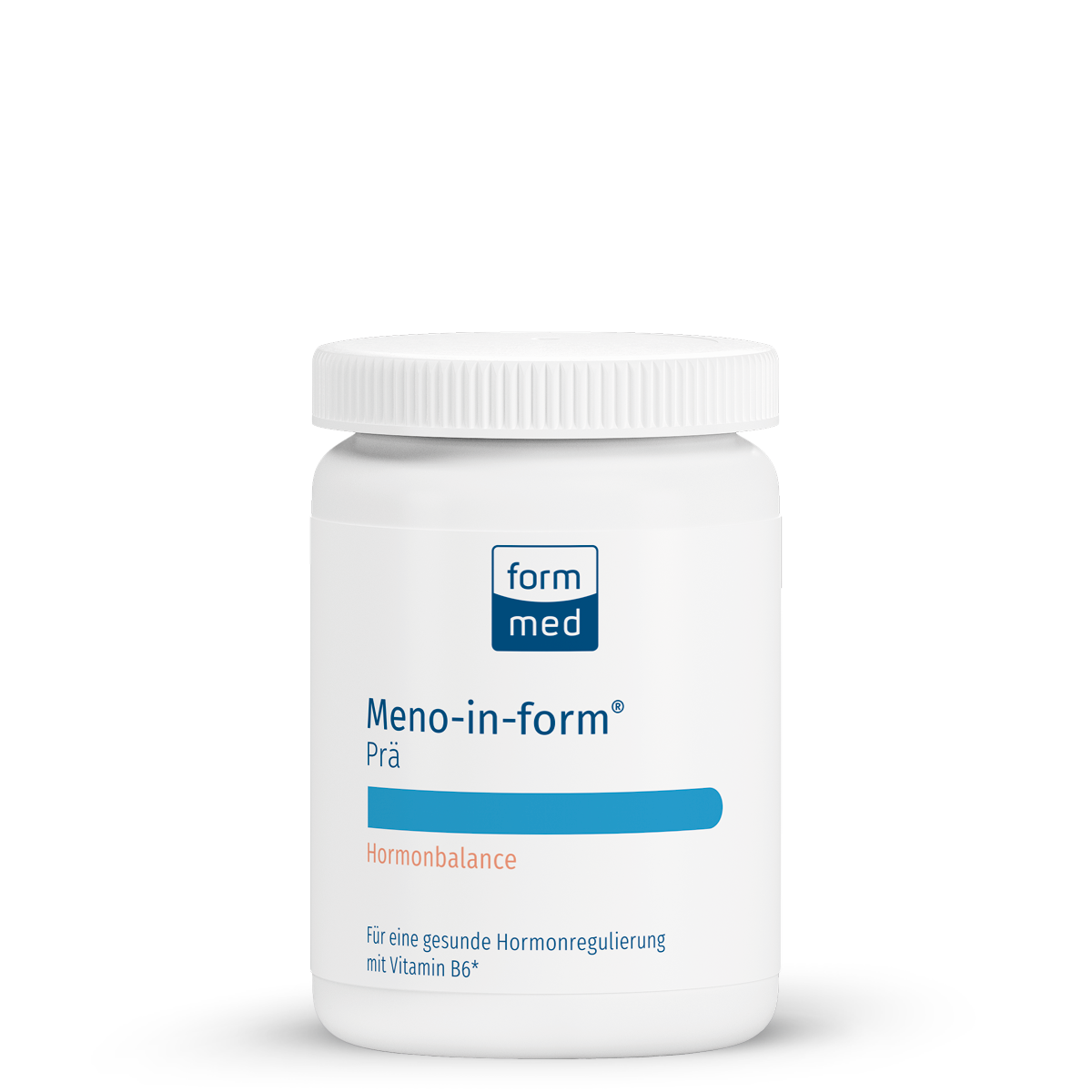
Meno-in-form® Prä has been specially developed for the phase leading up to menopause—the perimenopause—typically starting around the age of 40. It contains vitamin B6, which helps regulate hormonal activity, including that of progesterone and estrogen.
The formula is complemented by magnesium, as well as extracts of chasteberry (monk's pepper), lady's mantle, yarrow, ashwagandha, and wild yam.
The Gut: The Second Stage in Estrogen Breakdown
Once processed in the liver, estrogen travels via the bile into the gut. However, not all of this estrogen actually leaves the body; some gut bacteria produce an enzyme called beta-glucuronidase. This enzyme can break down the estrogen intermediates that were previously "packaged" in the liver. As a result, the estrogen becomes capable of being reabsorbed in the gut and re-enters the bloodstream—a process known as the enterohepatic circulation.
In principle, this is a useful mechanism that prevents valuable substances from being lost prematurely. However, if estrogen levels are already elevated, this process can be counterproductive, as it causes more estrogen to remain in the body.
In this context, dietary fiber plays an important role; it is a key nutrient for a healthy gut. Some types of fiber bind substances within the gut, while others are fermented by gut bacteria—both processes influence the activity of bacterial enzymes. Whether, and to what extent, this affects the enterohepatic circulation of estrogen is currently a subject of ongoing research.
Dietary fiber can be found, for example, in whole-grain products, legumes, and vegetables such as broccoli, kale, and Brussels sprouts.
A minimum intake of 30 grams of dietary fiber per day is considered a benchmark for an adequate supply; the FormMed guide on dietary fiber explains how this amount can be easily achieved in everyday life.Cruciferous vegetables also provide phytochemicals, such as glucosinolates. In the body, these are converted into substances including indole compounds—compounds currently being studied to determine whether they influence the initial stage of estrogen metabolism in the liver.
Chasteberry (Vitex agnus-castus): Plant Extract in Research on the Female Cycle
The extract of chasteberry (Vitex agnus-castus) is being scientifically investigated in the context of the female cycle. Researchers are exploring whether the plant's constituents can influence the secretion of prolactin—a hormone that plays a role in the function of the corpus luteum and, consequently, in the production of progesterone during the second half of the menstrual cycle. Potential effects on the ratio of estrogen to progesterone are also being studied.
A meta-analysis of randomized controlled trials indicated that chasteberry extract leads to an improvement in premenstrual symptoms compared to a placebo. Out of 21 clinical studies initially screened, three double-blind, randomized trials—involving a total of 448 participants—met the inclusion criteria. Women who took the extract were approximately 2.5 times more likely to experience an improvement in their symptoms than those in the placebo group.
Conclusion: A Holistic Perspective on Estrogen Dominance and Progesterone Deficiency
In functional medicine, what is described as "estrogen dominance"—often seen in women from their mid-30s onwards—is primarily driven by a decline in progesterone resulting from cycles in which ovulation does not occur. In most cases, this is not a matter of having too much estrogen, but rather an insufficient level of its counterpart, progesterone.
The liver and the gut play a central role in the breakdown and excretion of estrogen. The biochemical processes within the liver rely on vitamins and minerals, which act as essential cofactors. Furthermore, vitamin B6 contributes to the regulation of hormonal activity, while magnesium supports normal psychological function. In the gut, the intestinal flora may influence whether estrogen is eliminated from the body via stool or reabsorbed. Additionally, researchers are currently investigating chasteberry (vitex) extract in relation to the production of progesterone.
Frequently Asked Questions About Estrogen Dominance and Progesterone Deficiency
Typical signs of estrogen dominance include breast tenderness, water retention, mood swings, irritability, and weight gain that occurs despite no change in diet.
However, these symptoms can also have other causes. If symptoms persist or are severe, you should therefore consult a doctor to determine the exact cause.
A progesterone deficiency often manifests as PMS-like symptoms, such as breast tenderness, water retention, irritability, and inner restlessness. A shortened second half of the menstrual cycle and spotting before the period are also considered potential signs.
In addition, women frequently report sleep disturbances, as progesterone—through its metabolic byproducts—exerts a calming effect on the nervous system.
Many women describe a sense of inner restlessness, irritability, and a troubled state of mind—often accompanied by a feeling of tension in the breasts and abdomen, as well as difficulty falling asleep.
Unlike typical PMS, these symptoms are often more pronounced and persist over a longer period leading up to the menstrual period.
There is no standardized laboratory diagnostic procedure for "estrogen dominance," as it is not an official medical diagnosis. To assess hormonal status, physicians typically measure estrogen and progesterone levels in the blood serum—usually on a specific day during the second half of the menstrual cycle, given that both hormones fluctuate significantly throughout the cycle.
Thyroid hormone levels are also frequently checked, as thyroid dysfunction can cause similar symptoms.
No, a direct causal link has not been scientifically proven. However, the two can occur together: very heavy menstrual bleeding—which may arise in the context of relative estrogen dominance—increases iron loss and can, over time, contribute to an iron deficiency. Therefore, if you experience heavy bleeding, it is advisable to have your iron levels checked.
There is no one-size-fits-all solution. First, the underlying cause should be medically investigated—for example, to determine whether there is an actual progesterone deficiency or another hormonal or gynecological condition.
General measures often discussed include moderate alcohol consumption, getting sufficient sleep, reducing stress, engaging in regular physical activity, maintaining a diet rich in micronutrients and fiber, and limiting exposure to xenoestrogens. However, there is currently no proven evidence that estrogen dominance can be reversed solely through these measures.
A progesterone deficiency is not caused by the lack of a single vitamin. However, in the context of hormonal metabolism and associated mood swings, vitamin B6 is frequently discussed, as it acts as a cofactor in the regulation of hormonal activity and in the production of neurotransmitters that help regulate mood.
Well-supplied with micronutrients
Micronutrients for women in the premenopause
Ready for immediate dispatch - Delivery time approx. 2-5 days
Ready for immediate dispatch - Delivery time approx. 2-5 days
Ready for immediate dispatch - Delivery time approx. 2-5 days
Literature
Csupor, D. et al. (2019): Vitex agnus-castus in premenstrual syndrome: A meta-analysis of double-blind randomised controlled trials. Complement Ther Med. 47:102190. https://pubmed.ncbi.nlm.nih.gov/31780016/
Dragomir, R.E. et al. (2024): The Key Role of Vitamin D in Female Reproductive Health: A Narrative Review. Cureus. 16(7):e65560. https://pubmed.ncbi.nlm.nih.gov/39071069/
Durrani, D. et al. (2022): Vitamin B6: A new approach to lowering anxiety, and depression? Ann Med Surg. 82:104663. https://pubmed.ncbi.nlm.nih.gov/36268413/
Gore, A. C. et al. (2015): EDC-2: The Endocrine Society's Second Scientific Statement on Endocrine-Disrupting Chemicals. Endocr Rev. 36(6):E1-E150. https://pubmed.ncbi.nlm.nih.gov/26544531/
Grub, J. et al. (2021): Steroid Hormone Secretion Over the Course of the Perimenopause: Findings From the Swiss Perimenopause Study. Front Glob Womens Health. 2:774308. https://pubmed.ncbi.nlm.nih.gov/34970652/
Handy, A.B. et al. (2024): Estrogen and alcohol use in women: a targeted literature review. Arch Womens Ment Health. https://pubmed.ncbi.nlm.nih.gov/38878133/
Hu, S. et al. (2023): Gut microbial beta-glucuronidase: a vital regulator in female estrogen metabolism. Gut Microbes. 15(1):2236749. https://pubmed.ncbi.nlm.nih.gov/37559394/
Molina-Molina, J.M. et al. (2019): Determination of bisphenol A and bisphenol S concentrations and assessment of estrogen- and anti-androgen-like activities in thermal paper receipts from Brazil, France, and Spain. Environ Res. 170:406-415. https://pubmed.ncbi.nlm.nih.gov/30623888/
Puglia, L.T. et al. (2023): Vitex agnus castus effects on hyperprolactinaemia. Front Endocrinol. 14:1269781. https://pubmed.ncbi.nlm.nih.gov/38075075/
Vidgren, J. et al. (1994): Crystal structure of catechol O-methyltransferase. Nature. 368(6469):354-358. https://pubmed.ncbi.nlm.nih.gov/8127373/
Zhu, B. T. (2002): Catechol-O-methyltransferase (COMT)-mediated methylation metabolism of endogenous bioactive catechols and modulation by endobiotics and xenobiotics: importance in pathophysiology and pathogenesis. Curr Drug Metab. 3(3):321-349. https://pubmed.ncbi.nlm.nih.gov/12083324/